Introductory Catch-up to Part 1
Article by Dr Prabath C. Abeysiriwardana (Director (Planning), Ministry of Science and Technology) and Prof Theekshana Suraweera (Chairman, Sri Lanka Standards Institution)
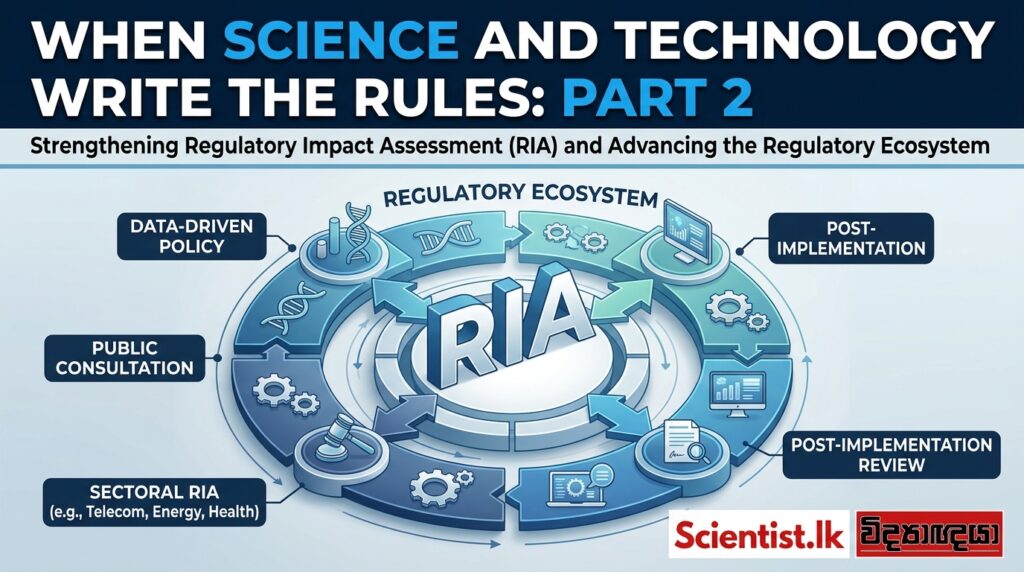
In Part 1, we explored how RIA ensures regulations solve real problems, generate public benefits, and involve key stakeholders. We also looked at the origins of RIA globally and Sri Lanka’s early steps in embedding evidence-based regulation. Now, we turn to the critical role of science and technology in strengthening RIA and the regulatory ecosystem.
Science and Technology (S&T): The Engine of Stronger RIA
Most modern regulatory challenges are deeply technical:
- Genetic modification – ensuring biosafety and ethical compliance
- Cybersecurity vulnerabilities – protecting data and digital infrastructure
- AI decision-making – regulating algorithmic transparency and accountability
- Quantum communication – managing emerging technologies with high societal impact
- Chemical safety – safeguarding health and the environment
- Renewable energy integration – balancing innovation with grid stability and sustainability
- Robotics – setting standards for autonomous systems, safety, industrial applications, and ethical use
Without scientific involvement, there is a risk of regulating based on fear, assumptions, or outdated knowledge. Science supplies evidence, foresight, modeling, and digital tools that transform RIA into a living and adaptive approach to governance.
National Quality Infrastructure (NQI): A Pillar for Regulatory Assurance
Sri Lanka’s NQI ecosystem plays a central role in ensuring that rules are not just written, but meaningful and enforceable. It includes:
- Standards (SLSI)
- Accreditation (SLAB)
- Metrology services (MUSSD)
- Conformity assessment bodies
- Product testing and certification labs
Through NQI, science provides the practical foundation for fair trade, safety assurance, biosecurity, and export competitiveness. When embedded into RIA, this infrastructure prevents regulations from becoming symbolic paperwork. They gain enforceability and credibility.
The Ministry of S&T: A National Anchor for S&T-Centered RIA
The Ministry of Science and Technology uniquely operates above sectoral boundaries. It deals with health, agriculture, defense, education, environment, and industry all at once. That neutrality positions the ministry to become Sri Lanka’s guardian of science-based regulatory excellence.
The Ministry can lead by:
- Establishing national guidelines for RIA in innovation-intensive sectors
- Coordinating scientific expert networks for regulatory consultation
- Building digital tools for regulatory analytics and monitoring
- Ensuring alignment between innovation policy and regulatory frameworks
- Supporting regulators with training in data-driven decision making
- Utilizing S&T institutions (NIFS, ITI, universities) to test assumptions via research
S&T: Driving Smarter, Evidence-Based Regulation for the Future
RIA is no longer a bureaucratic formality—it is a vital tool for evidence-based policymaking in a rapidly evolving technological landscape. S&T lies at the heart of this transformation, providing the expertise, data, and foresight necessary to design regulations that are effective, fair, and forward-looking. From biotechnology to robotics, AI, and renewable energy, the challenges of the 21st century demand regulatory frameworks that are informed, adaptive, and ethically grounded.
In Sri Lanka, the Ministry of Science and Technology, together with the National Quality Infrastructure, is uniquely positioned to lead this evolution. By integrating scientific rigor into every stage of regulation—design, implementation, and monitoring—the country can build a robust RIA ecosystem that protects public welfare, promotes innovation, and strengthens international competitiveness. The future of governance lies in rules that are not only enforced but intelligently designed, and in this endeavor, Science and Technology are the true engines driving smarter, more resilient regulation.
Article By Dr Prabath C. Abeysiriwardana (Director (Planning), Ministry of Science and Technology) and Prof Theekshana Suraweera (Chairman, Sri Lanka Standards Institution)