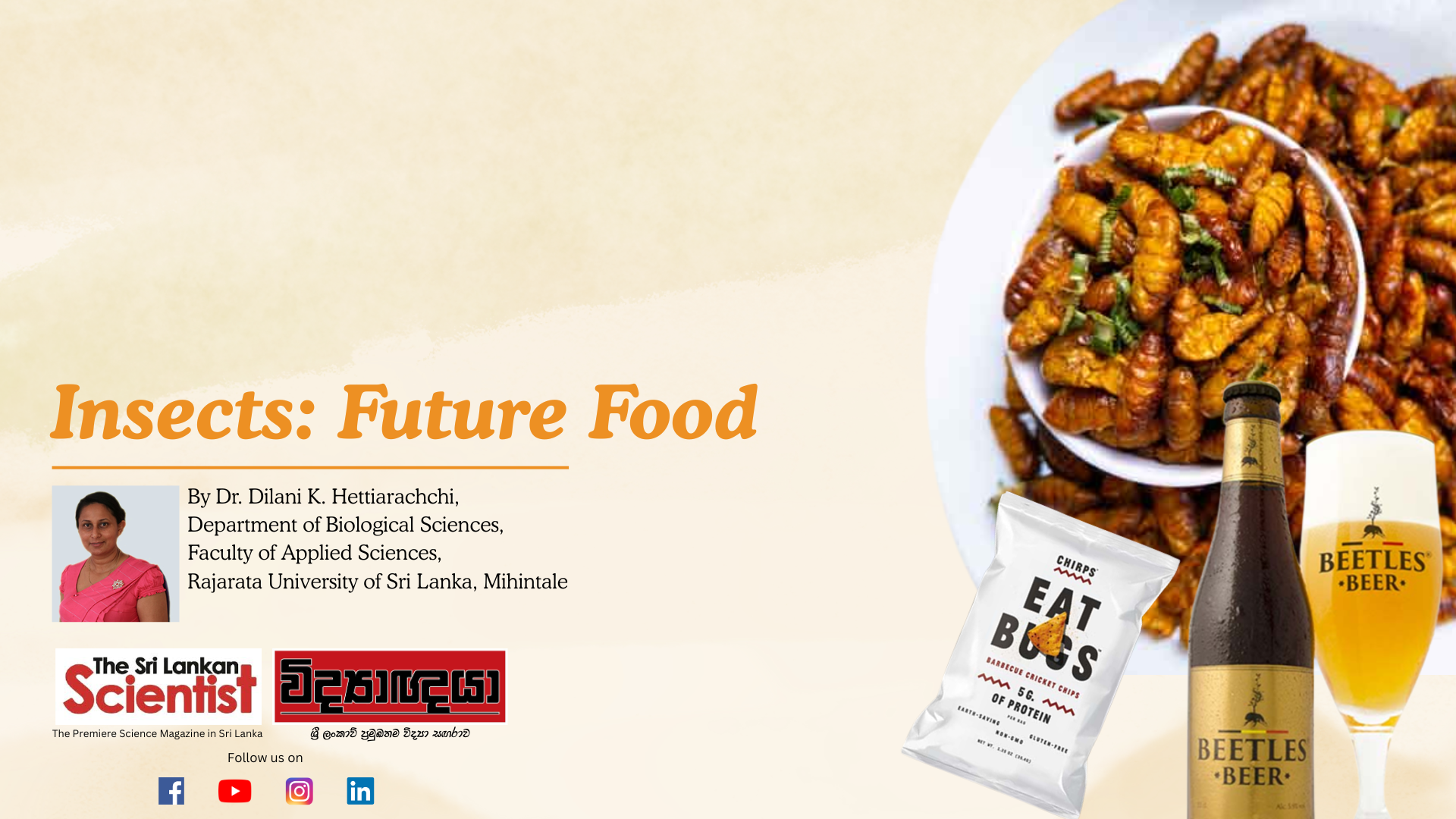
By Dr. Dilani K. Hettiarachchi
The world population is increasing at an alarming rate. According to the United Nation human population will increase to 9.7 billion in 2050 from 8.2 billion in 2024. But we only have one globe with a constant arable land of about 57 million square miles, which we use for living, transport, industries and farming. How can we feed the growing population using the constant land area on Earth? This is where genetically modified plants and animals, sustainable farming, and precision agriculture like technologies come in. The initial cost incurred for these technologies, plus maintaining ecological and economical balance are a problem. Therefore, alternative food sources with high nutritional value that can be produced sustainably with minimal use of resources are always welcomed. Currently, the attention of many researchers is with alternative food source that fulfil all the above requirements: INSECTS. Insects have been part of the human diet for thousands of years, consumed by diverse cultures across the globe—either as a staple food or as a resource during times of need (Xiaoming et al., 2010). Historically, these edible insects were harvested from natural forests. Even though forests contain an abundant number of insect species, it is unfortunate that they are the least studies group of animals, and very little is known about the life cycle, population dynamics and management potential of edible forest insects in the world. However, with tim,e people have grown fond of eating insects in various forms, and now nearly 2 billion people in 113 countries consume insects (Van Huis et al., 2022; Tao and Li, 2018).
Feeding on insects is called Entomophagy. There are about 2,111 species of insects that have been identified as edible insect species. Among the,m 659 species of Coleopterans, 362 species of Lepidopterans and 278 species of Orthopterans are commonly consumed by humans in the world (Table 1).
Table 1: Most commonly consumed insects around the world
| Group of insects | Orders | Number of species estimated to be present | Number of recorded edible insect species |
| Beetles | Coleoptera | 370,000 | 659 |
| Caterpillars/Butterflies | Lepidoptera | 165,000 | 362 |
| Anys, Bees, Wasps | Hymenoptera | 198,000 | 321 |
| Grasshoppers, Locusts, Crickets | Orthoptera | 20,000 | 278 |
| True bugs | Hemiptera | 82,000 | 237 |
| Dragonflies | Odonata | 5,500 | 61 |
| Termites | Isoptera | 2,750 | 59 |
| Flies | Diptera | 122,000 | 37 |
| Cockroaches | Blattidae | 4,000 | 37 |
| Others | 33,164+ | 45 |
Source: Orkusz,2021
Among the continents of the world, the America rank first, with 279 recorded edible insect species and insect consumption reported in 36 countries. Africa comes second, followed by Asia, where 29 countries are known to consume insects (Orkusz,2021). In Asia, China and Thailand lead the insect market, and the number of countries starting to be entomophagy is increasing. The main reason for insect to be considered as future food of the world is mainly due to their high nutritional value. According to Weru et al. (2021), the daily energy requirements for adults range from 2,300 to 2,900 kcal for males and 1,900 to 2,200 kcal for females. A 100-gram serving of dried Phasus triangularis (a butterfly species) provides 762 kcal, meeting approximately 26.27% of the daily energy needs for adult males and 34.64% for adult females. In comparison, chicken breast delivers only 98 kcal per 100 grams, while beef sirloin provides 112 kcal per 100 grams (Orkusz, 2021). The energy content of both insects and traditional meats is influenced by various factors such as species, muscle type, and developmental stage. However, insects often surpass meat in overall nutritional value. The following table (Table 2) shows some of the common nutritional values of a few selected insect species and meat:
Table 2: Common nutrition values of a few selected insect species and common meat consumed by humans
| Scientific name | Common name | Energy kcal/100g | Protein (g/100) | Fat (g/100) | Fiber (g/100) | |||
| Phasus triangularis | A moth species | 762.00 | 15.80 | 77.00 | – | |||
| oxya chinensis sinuosa | rice grasshopper | 396.40 | 74.28 | 3.03 | – | |||
| Proarna hilaris | Cicadas | 401.00 | 72.20 | 4.00 | – | |||
| Gryllus bimaculatus | Field cricket | – | 58.32 | 11.88 | 9.53 | |||
| Holotrichia serrata | June beetle | – | 51.74 | 5.41 | 19.31 | |||
| Sitophilus zeamais | Maize weevil | – | 16.49 | 6.70 | 3.88 | |||
| Trinervitermes germinatus | Termite | 395.50 | 26.49 | 26.57 | 8.39 | |||
| Chicken breast | 98 | 21.5 | 1.3 | – | ||||
| Chicken drumstick | 125 | 17.8 | 6 | – | ||||
| Pork shoulder | 13.2 | 16.89 | 7.05 | – | ||||
| Mutton leg | 196.56 | 15.12 | 15.12 | – | ||||
| Beef sirloin | 112 | 20.1 | 3.5 | – | ||||
Sources: Weru et al., 2021 and Orkusz, 2021
When compared to body mass of insects they are with high protein content and unsaturated fatty acids. Not only that they have minerals (Na, K, Ca, P. Mg, Mn, Fe, Zn, Cu, I) and Vitamins (A,E,C,B1,B2,B3,B6,B12). Exoskeleton of many insects contain chitin which provide fibers to the diets, but slaughtered meat does not contain fiber.
Another reason for the insect to be future food is that they are sustainable, more environmental friendly and use minimal resources (Halloran et al., 2018). Growing human population demands increase food production which lead to developments which impose heavy burden to land, water, and energy sources. Farming including raising livestock will contribute to lot of environmental problems. But raring insects is more ecofriendly as their conversion efficiency is high. They can easily convert plant proteins to insect proteins when compared to mammals and birds (Deroy et al., 2015). For instance, crickets need under 2 kilograms of feed to gain 1 kilogram in body weight (Collavo et al 2005). In comparison, producing the same weight gain requires approximately 2.5 kilograms of feed for chickens, 5 kilograms for pigs, and as much as 10 kilograms for cattle (Smil, 2002). Further, insects require significantly less land and water compared to cattle rearing. To rare insects, small space is enough and they can be reared on waste which also helps to decrease the environmental contaminations. All these factors have made insects the future food.
In some countries the markets are having insects with tempted presentations. Therea are various products coming out to the market with insect flour. Some food like chocolate dipped grasshoppers or deep-fried crickets are popular. Breakfast cereals, crisps, bars and other snacks using different locusts, crickets, beetles are present in world market. Not only that, in countries like Thailand and China where entomophagy is popular, there are courses offered to farmers on how to rare edible insects. Surely, it is going in the direction where insects becoming the future food of humans.
References:
Collavo, A. L. B. E. R. T. O., Glew, R. H., Huang, Y. S., Chuang, L. T., Bosse, R. E. B. E. C. C. A., & Paoletti, M. G. (2005). House cricket small-scale farming. Ecological implications of minilivestock: potential of insects, rodents, frogs and snails, 27, 515-540.
Deroy, O., Reade, B., & Spence, C. (2015). The insectivore’s dilemma, and how to take the West out of it. Food Quality and Preference, 44(1), 44-55.
Halloran, A., Flore, R., Vantomme, P., & Roos, N. (Eds.). (2018). Edible insects in sustainable food systems (Vol. 10, pp. 978-3). Cham: Springer.
Orkusz, A. (2021). Edible Insects versus Meat—Nutritional Comparison: Knowledge of Their Composition Is the Key to Good Health. Nutrients, 13(4), 1207. https://doi.org/10.3390/nu13041207
Smil, V. (2002). Worldwide transformation of diets, burdens of meat production and opportunities for novel food proteins. Enzyme and Microbial technology, 30(3), 305-311.
Tao, J., & Li, Y. O. (2018). Edible insects as a means to address global malnutrition and food insecurity issues. Food Quality and Safety, 2, 17–26. https://doi.org/10.1093/ fqsafe/fyy001.
Weru, J., Chege, P., & Kinyuru, J. (2021). Nutritional potential of edible insects: a systematic review of published data. International Journal of Tropical Insect Science, 41, 2015-2037.
Van Huis, A., Halloran, A., Van Itterbeeck, J., Klunder, H., & Vantomme, P. (2022). How many people on our planet eat insects: 2 billion?. Journal of Insects as Food and Feed, 8(1), 1-4.
Xiaoming, C., Ying, F., Hong, Z., & Zhiyong, C. (2010). Review of the nutritive value of edible insects. Forest insects as food: humans bite back, 85.