
By Dr. K.O.L. Chathurika Karunanayake and Hasitha S.B. Katugaha
Mushrooms as a source of nutrition
Mushrooms are fruiting bodies of basidiomycete fungi with approximately 2000 edible species known to be distributed worldwide. Among these, Pleurotus spp. Commonly known as oyster mushrooms are the most cultivated due to their short cultivation period, low cost, and ease of cultivation. Oyster mushroom is known for its rich content of vitamin C, vitamin B complex, and high protein content, along with mineral salts, which are essential for the human body. Its potential to grow in a wide range of temperatures and different agro-based residues and adaptability to various agro-climatic conditions on different agricultural waste have made the cultivation of Oyster mushrooms even more attractive.
Mushroom cultivation in Sri Lanka
The initiative for mushroom cultivation in Sri Lanka was taken by the Export Development Board in the mid-1980s while launching a project to produce mushroom spawn. However, the industry took wings as an agricultural commodity in Sri Lanka only in the late 1980s.
The four most common types of commercially grown mushrooms in Sri Lanka are the American oyster (Pleurotus ostreatus), Bhutan oyster (Pleurotus eryngii), Abalone (Pleurotus cystidiosus), and Button mushroom (Agaricus bisporus). The recently released variety Makandura white (MK-White; Calocybe sp.) is widely unknown and yet to gain popularity. Mushroom cultivation is of vital importance in Sri Lanka. Being a third-world developing country facing many nutritional challenges for its people, mushrooms provide a low-cost yet nutritionally acceptable alternative to high-cost animal proteins. American oysters (Pleurotus ostreatus) are one of the largest sources of protein for the people of Sri Lanka. Compared to other mushroom species, American oysters (Pleurotus ostreatus) are one of the most consumed types among the people of Sri Lanka, due to their low manufacturing cost, which makes it affordable to the masses.
The problem with polythene
Unfortunately, this valuable source of low-cost protein comes with a threat to the environment due to the methods used in its cultivation. Normally, farmers use non-biodegradable polypropylene (PP5) to cultivate mushrooms because plastic is a good water retainer in the substrate, which is very important for mushrooms, which are composed of 80% water. The substrate, which has been sterilized or pasteurized and then hydrated to a water content of 55–70%, is the source of water that is necessary for the growth of mushrooms. Plastic also acts as a cover that stops water evaporation, contamination by unwanted microorganisms (because plastic is non-nutritive), and pest infestation. Among the significant threats currently facing the mushroom industry is the disposal of polyethylene bags used to fill substrates. These polythene bags used to fill up substrate used in mushroom cultivation are used only for one growing cycle. Research shows that approximately 18 g of non-biodegradable polythene bags are discarded into the environment for every 450g of oyster mushroom produced, which is a huge toll on the environment. Furthermore, these traditional plastic bags have a lengthy shelf life in landfills, where they progressively decompose into microplastics that pollute water and soil and make their way into the food chain. Due to their inability to be recycled due to contamination from substrate residues, the majority of used mushroom bags wind up in landfills. Anaerobic conditions slow down decomposition even in landfills, although certain fungi, such as Pestalotiopsis microspora, can break down plastic.
Our intervention
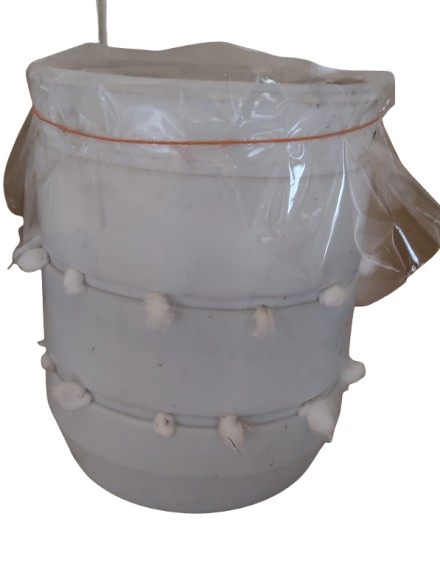
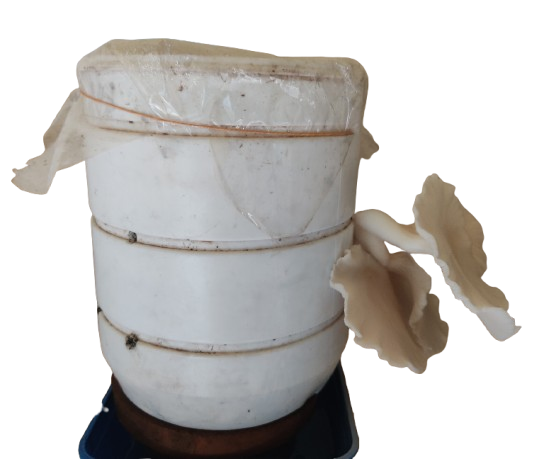
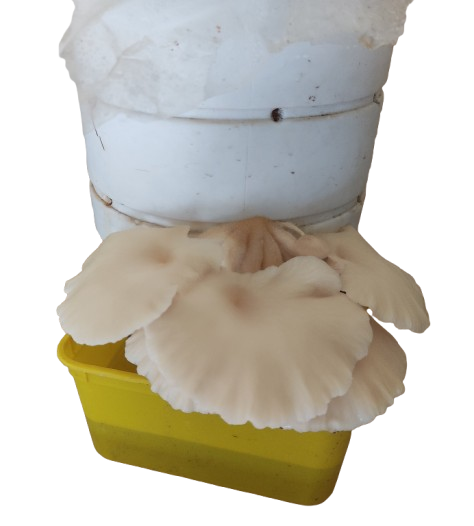
In response to this challenge, an initiative was taken to investigate the feasibility of using once-used and discarded 4-liter ice-cream containers for the cultivation of mushrooms. This initiative not only tackles the issue of single-use polythene in mushroom cultivation, but also successfully addresses the issue of once-used and discarded plastic ice cream containers, which are found in abundance in commercial enterprises related to the food industry. These discarded 4 L ice-cream containers (20 cm in height and 16.5 cm in diameter) were recycled (cleaned) and reused in mushroom cultivation.
The results showed that there was no significant difference between the growth or yield characteristics depending on whether the mushrooms were grown in single-use polythene bags or reusable ice-cream containers. Growth characteristics such as the time taken to harvest mushrooms, total yield, biological efficiency, the maximum diameter of the mushroom surface, and the total number of mushrooms were not affected by the containers used for cultivation. Further, external factors such as temperature, moisture content, and pH were also not affected by the container. As such, it can be stated with evidence that reusable plastic containers are a viable and environmentally safe, and sustainable alternative to the typical use of polyethylene bags in growing oyster mushrooms.