
By Dr. Dilani K. Hettiarachchi and Dr. K.O.L. Chathurika. Karunanayake
Freshwater habitats and man-made tanks in Sri Lanka
Sri Lanka is a country with a variety of lentic and lotic freshwater habitats distributed throughout the island. The lotic habitats, or flowing water containing habitats, comprise a large number of rivers and streams. These originate from the central hills (i., Peak Wilderness) and other montane regions. The lentic habitats, which are relatively still terrestrial waters, include man-made lakes or tanks, reservoirs, as well as natural stagnant water bodies such as forest pools, inland freshwater marshes, villus, floodplains, and paddy fields. According to the literature, a total of approximately 12,000 – 16,000 small man-made tanks are found distributed across 70 well-defined river basins in the dry zone. Man-made tanks or ‘Wewa’ (plural Wew) can basically be divided into two categories as perennial tanks and shallow seasonal tanks. Over 127,070 ha of land is covered by man-made tanks and canals, which are found especially in the dry zone of Sri Lanka. Almost all the perennial tanks and shallow seasonal tanks fall into the tank cascade system (TCS) or ‘Ellangawa’, which are interconnected reservoirs and irrigation systems. Even though the history of these tanks goes back as far as 2000 years, most of the TCS are still functional. The cascading water flow affects the water quality of the tanks and in turn, can influence the unique diversity in these man-made tanks. Aquatic plants, all seed-bearing plants, whose photosynthetically active parts are submerged in water or float on the water surface permanently or at least for several months in each year, play a crucial role in maintaining the biodiversity of tanks in the dry zone. There are about 370 aquatic plant species, belonging to 64 families in Sri Lanka, and from these species, approximately 12% are endemic.
Man-made tanks or ‘Wew’ in Anuradhapura
Anuradhapura District belongs to the North Central Province of Sri Lanka, is the largest district in the island with an area of 7,179 km², of which 515 km² are reported to be covered by man-made tanks and canals, rich in diverse floral communities. The main purpose of these man-made tanks was and still is to conserve water for irrigation, and there is much focused research on water management, fishery management, and cascade system management.
Ecological and ethnobotanical uses of aquatic plants
The presence of aquatic plants in water bodies is also of prime importance. It is very important for the conversion of solar energy to chemical energy and enriching water with fresh oxygen during the process of photosynthesis. Thus, the aquatic plants or aquatic macrophytes play a significant role in maintaining the quality of a freshwater ecosystem by photosynthesis, being the primary link in the food chain, nutrient recycling and control of pollution. Furthermore, many aquatic plants have played a fascinating role in the life of man from primitive times onwards in one form or the other, deriving economic benefits by being sources food, fiber, paper pulp, medicine, green manure or of ornate or religious value.
The attitude of the rural community towards aquatic plants
Do villagers consider aquatic plants to have value in their day-to-day life? Do they utilize these plants for their benefit? Is it a sustainable use? Overuse or underuse?
To explore the answers, a questionnaire survey was conducted at the Anuradhapura district, mainly focusing on the nearby communities of three tanks: namely ‘Mihintale wewa’, ‘Maradankadawala wewa’, and ‘Thibbatuwewa’. Five hundred questionnaires were filled out during the survey to evaluate the attitude of the public towards aquatic plants.
In addition to the primary functions such as providing oxygen & food for aquatic fauna, recycling nutrients, the aquatic plants which inhabit these tanks have been a rich source, reaping many benefits to the neighboring village communities for centuries, but unfortunately, a small scale.
There were fourteen species of aquatic plants identified as economically important by the community (Table 01).
| Common Name | Scientific Name | Uses |
| Lotus (Nelum) | Nelumbo nucifera | Food, Medicine, Flowers, and Decorations of the aquarium |
| Water lily (Olu) | Nymphaea pubescens | Food, Medicine, and Decoration of aquaria |
| Blue lotus (Nil Manel) | Nymphaea spp. | Medicine and Decoration of aquaria |
| Water hyssop (Lunu-wila) | Bacopa monnieri | Medicine and Decoration of aquaria |
| Swamp morning-glory (Kankun) | Ipomoea aquatic | Food |
| Joyweed (Mukunu-wenna) | Alternanthera sessilis | Food |
| Kekatiya | Aponogeton spp. | Food, Medicine, and Decoration of Aquaria |
| Katu-Ikiriya | Hygrophila schulli | |
| Salvinia | Salvinia molesta | Bio-fertilizer |
| Water hyacinth (Japan-jabara) | Eichhornia crassipes | Bio-fertilizer, Flowers |
| Valisnaria | Vallisneria spp. | Decoration of aquaria |
| Cattail (Hambu-pan) | Typha angustifoliaa | Weaving of Baskets/bags/mats |
| Water serpant (Diya sarpa) | Hydrilla verticillata | Decoration of aquaria |
| Thunhiriya pan | Cyperus spp. | Weaving of Baskets/bags/mats |
Aquatic plants can provide three types of food, namely foliage for use as a green vegetable, grains or seeds that provide proteins, starch, or oil, and swollen fleshy roots that provide carbohydrates, such as starch. Ipomoea aquatica (‘kankun’) and Alternanthera sessilis (‘Mukunu-wenna’) young shoots and leaves were consumed, while Nelumbo nucifera (‘Nelum’) (Figure 03), it was the rhizomes, and in the case of Nymphaea pubescens (‘Olu’), it was the flowering stalk that was consumed by the community. Some villagers take the seeds of Nymphaea pubescens (‘Olu’) in place of rice. But it was unfortunate to know that some other aquatic plant species, such as Neptunia oleracea, Ottelia alismoides, and Ceratopteris thalictroides, which are present in the Anuradhapura District, are not consumed at all.
It was amazing to reveal that even in this day and age, villagers still use their traditional knowledge of aquatic plants to treat common ailments such as stomach disorders, cough in small children, skin diseases, diabetes, and discomfort caused by gas accumulation. Bacopa monnieri (Figure 01) was the most commonly used, whereas Aponogeton spp. (Figure 02), Nymphaea spp. and Hygrophila schulli are also trusted. Hygrophila schulli was specifically used by the community to heal kidney problems, and the extracted oil was used for medication. But most of the aquatic plants have not been fully discovered for their therapeutic properties, and some that were cited in published literature, such as Alternanthera sessilis and Ipomoea aquatica, are not known to the community.
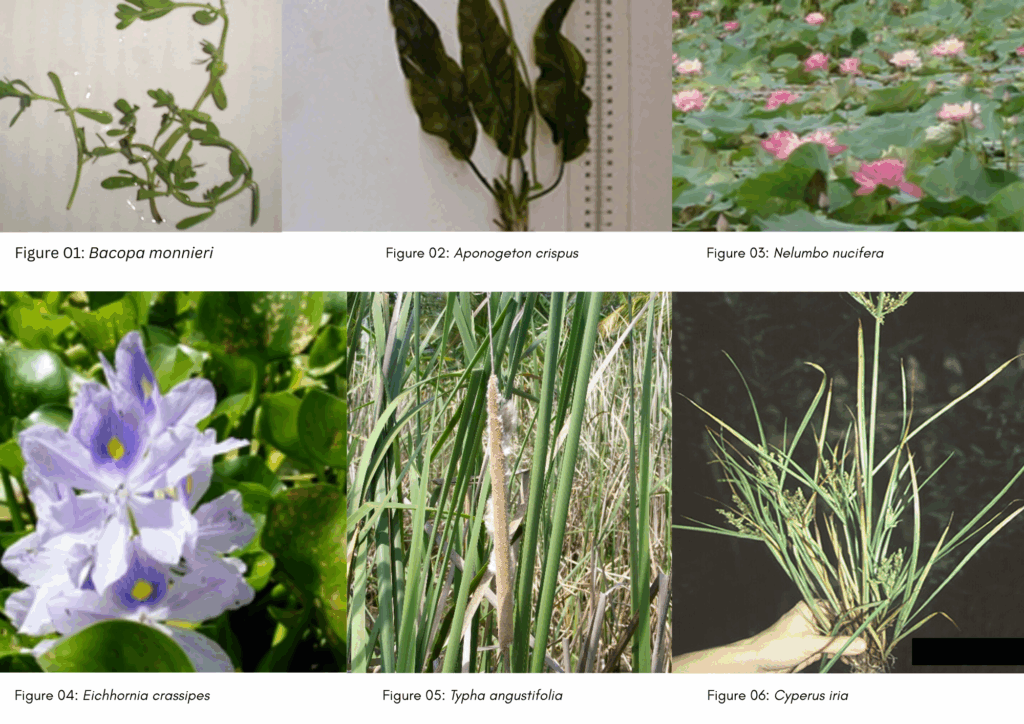
Harvesting flowers for offering is a common practice of the villagers regardless of the season. Flowers such as Nelumbo nucifera (Figure 03), Nymphaea pubescens, and Eichhornia crassipes (Figure 04) are some of the flowers usually harvested from the surveyed area.
It was encouraging to see the community benefiting from invasive species such as Eichhornia crassipes and Salvinia molesta by acting as bio-fertilizers. However, there exists a risk of spreading these plants to other water bodies. Some plants, such as Cyperus spp. (Figure 05) and Typha angustifoliaa (Figure 06), which are considered weeds, are used by villages for weaving baskets, mats, and hats. But none of these were used optimally and sustainably, as utilization was ad hoc.
Although there are a lot of opportunities to derive benefits from aquatic plants, the survey suggests that the rich resource readily available in the form of aquatic plants in Anuradhapura is currently underutilized. Mainly due to ignorance or lack of proper knowledge on possible derivatives or by-products, or alternate uses of these plants. There is ample possibility to empower these villagers to derive economic benefits sustainably from aquatic plants to enhance their financial status and to change their lives for the better as entrepreneurs with proper inputs from relevant authorities.